Thursday, 19 June 2014

WC2014 Review: Argentina vs Bosnia & Herzegovina

Line-ups:


Argentina (5-3-2) - Romero; Zabaleta, Campagnaro, Fernandez, Garay, Marcos Rojo; Mascherano, Maxi Rodriguez, Di Maria; Aguero, Messi.
  • Sabella began with a 5-man back-line as Fernando Gago sustained a knock in training. 
  • Zabaleta and Rojo were expected to provide width to this side, but Rojo plays as a Centre-back for his club. 
  • Sabella moved away from the 4-3-3 he used in qualification, and chose to go with a particularly lightweight midfield - Di Maria is a winger who only played this season as a central midfielder, and Maxi Rodriguez isn't particularly kown for his ball-winning ability.
Bosnia (4-5-1) - Begovic; Mujdza, Spahic, Kolasinac, Bicakcic; Hajrovic, Pjanic, Misimovic; Besic, Lulic; Dzeko.
  • A fairly unfamiliar lineup, but one that got Bosnia to their first ever World Cup. The players to look out for would be Roma's Miralem Pjanic (who I've admired for quite a while), and Manchester City man Edin Dzeko. 
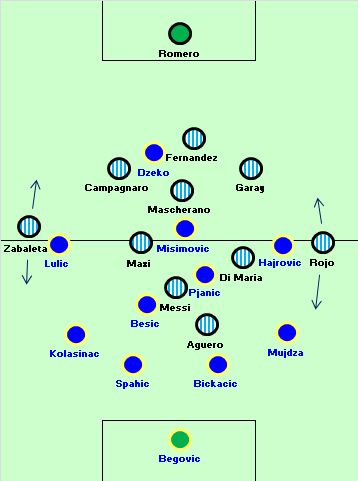
Courtesy: Zonal Marking

First Half: Score 1-0 to Argentina.


  • This was a pretty weak first half by Argentina. The lucky own goal aside, the 5-3-2 misfired horribly. Bosnia overran the Argentine midfield rather easily, pressing with rabid intensity and winning the ball in dangerous areas, swarming ahead with energy. With Mascherano being the only defensive name in midfield, the back-line inevitably became the first line of defense. 
  • The Argentine midfield saw very little of the ball in meaningful positions, which meant that Messi had to drop pretty deep to see the ball. He already had two men tracking him, and dropping into a crowded, energetic midfield only made it worse. He was practically anonymous in the first half, and couldn't link up with Di Maria or Aguero.
  • Aguero lacked sharpness and his contribution in the game, let alone this half, was very poor.
  • Zabaleta and Rojo were pinned back because of the midfield pressure. And this translated into very little width for the side, which made things worse.
Notes:
  • Argentina barely saw any shots on target. Messi saw very less of the ball and was surrounded and shut down quickly even when he did.
  • Bosnia were very dangerous on the break. Coupled with the static, outnumbered midfield and the rather slow back-line, this translated into increased pressure on the back 5.

Second Half: Ends 2-1 to Argentina.

  • Sabella realized his tactical mistake, and brought on Gago and Higuain, for Campagnaro and Maxi Rodriguez. 
    • A swtich to the reliable 4-3-3, with Masch acting as the defensive shield, Gago the ball recycler, and Di Maria the energetic midfielder linking defense and attack. 
    • Higuain and Aguero spear-headed the attack with Messi just behind them, forming a fluid 3-man strike force.
  • This tactical switch worked like a charm, as Gago's sensible work with the ball provided Di Maria and Messi with an outlet ball in the final third, the area where they're most potent. Also Gago's defensive work meant that Masch had a partner in closing down the Bosnian midfielders. Pjanic saw much less of the ball in the second half.
  • Higuain, although he was wasteful and couldn't link up with Messi or Aguero, did well in pushing back the Bosnian defenders. This opened up space for Messi, and that too in an area closer to the final third. Same goes for Aguero. But strikers of their calibre should be contributing much more.
  • Argentina began bossing the game in this half, but they couldn't translate that into meaningful shots or goals. Too often the pass was over-hit or the first touch was lacking. Even the usually buccaneering Di Maria ran into walls of defenders. Messi began influencing proceedings more, but even he couldn't get the final ball right. The fans began baying for the Barcelona Messi.
  • Messi's Goal:
    • It was thing of beauty. It was all Messi, dropping deep near the halfway line to receive the ball, then bursting ahead, exchanging a simple one-two with Higuain, running directly at the back-line, evading two tackles, and then arrowing the ball into the net off the post. Simply magnificent.
    • He utilized the space between attack and midfield created by Higuain's run, and burst in there to do what he does best. It was sumptuous stuff, and Messi in his element. 
    • With the stadium rocking now, every burst forward looked potent. This was the goal the side needed. 
  • Ibisevic's Goal: 
    • This was a clanger from Argentina's perspective. They slacked off towards the end. The back-line was disorganized and lazy, with the midfield not exerting even a token amount of pressure on the ball carrier. 
    • There was too much space between the two centre-backs which Ibisevic used to run past his marker and lose him. This highlighted our inability to deal with a traditional two-striker system.
    • Romero's fumble as a goalie was just unforgivable, especially if we have title aspirations.

Remarks:

  • It's a very shaky back-line that need to work a lot on the training ground. We will struggle a lot against a fluid, interchanging strike-force. Or even a direct, physical striker. And Romero's slip does not inspire any confidence. 
  • While Gago will defintely start the next game, the lack of depth in this Argentina squad is scary.
  • Aguero and Higuain need to turn up, and start influencing proceedings more if this side are to have any chance at the World Cup. Over-reliance on Messi is not a good thing, as Barcelona can attest to. Movement will be the key to unlocking a well-drilled, ultra-defensive Iran side.
  • Even in a 4-3-3, this side lacks natural width. Rojo can't bomb forward effectively, while Higuain and Aguero are more central strikers. The lack of options can come really restrict us.
  • Sabella's organization of the team when they are chasing the ball needs to improve a lot, because we just look disorganized and out of sync, waiting to be carved apart by two incisive passes. Also, the lack of pace while tracking back is a glaring weakness.

Friday, 13 June 2014

WC2014 Notes: It's Time!

It's World Cup season!

It's that time again, when in spite of knowing the specific shortcomings of a lopsided Argentine squad, I'll root for them with all my heart. When in spite of mathematical odds and detailed tactical sheets, I hope to see the Albiceleste triumph.

For this edition, I thought I'd chronicle the World Cup through my blog. I've supported Argentina ever since I was a kid. They were my introduction to the sport - courtesy my fanatical cousins - and have always remained my benchmark for the way the game should be played. I remember the days of the maestro Riquelme, the beauty of one-touch football. Not the slow, sterile tiki-taka stuff that Spain parades, but a vibrant, effervescent style, full of energy and verve. The original way. The Argentine way.

And then there's Germany. I don't remember the precise moment I began supporting them, but I remember being in awe of Oliver Kahn in 2002, and cheering them on vociferously in 2006. They captured everyone's imagination with that breathtaking run in 2010 with a young squad, playing swift, incisive football. But the way they imploded in Euro 2012, that was a dagger through my heart. And that sowed the seeds of doubt in my mind against Joachim Low and his tactical flexibility.

Anyway, rhapsodizing aside, I'll be chronicling this World Cup from the vantage point of both these teams. They're close to my heart, and I love watching them play. I spend a considerable chunk of my day devouring football news, so hey, that habit may finally prove handy! There will be a lot of amateur analysis, a fair collection of expletives and reactions, and I'll try to incorporate stats from Opta. And most of it will be unedited and fairly disparate, maybe even random. Just like my live-tweets over @adarshmathew92.

Honestly, I'll be making this stuff up as I go along.

I'd originally envisaged this project as a fun, private one, to keep myself entertained. But Sony's coverage of the event has disappointed me massively. I understand that you need star power in coverage, especially in India. But the case here isn't one of introducing a sport to a completely new market. We have a fairly intelligent and a very passionate footballing community; I've seen fistfights break out over football games. Sony could at least treat us with a modicum of respect, like intelligent viewers who know the game. Peter Crouch and Mikael Silvestre as pundits is just laughable. John Abraham and the-guy-who-does-IPL are just incompetent nincompoops. Every person in the country who's even half-interested in the game is tuning into Sony LIV right now. This would've been the best chance to introduce this audience to local pundits who cover Indian Football, promote the local game. They would definitely bring in a greater degree of enthusiasm and understanding to the coverage, and would also get a chance to familiarize themselves with the audience. Even more, Sony could've set themselves apart by being promoters of local talent, unlike STAR Sports and TEN Sports who just regurgitate England's telecast. Such a wonderful chance, blown to dust.

So, a part of me is doing this just to show that sensible, intelligent coverage of an international footballing event by local entities is possible and feasible. I'm not a sports journo, or qualified in any sense of the word. I'm just your regular footballing nutjob who loves his Manchester United crest a little too much.

So here's to an excellent World Cup. May you be thrilled and entertained, as football always aims to do.

Next in the series: Detailed previews for Argentina and Germany!

Thursday, 19 December 2013

Non-Conventional Oil and OPEC's Drawdown

The OPEC’s traditional stranglehold over the world’s oil resources has eroded over the past few years. Part of it can be attributed to improved technology resulting in engines that are more efficient, along with the community’s desire to wean itself off oil. But a large chunk of this must be attributed to the discovery of other avenues of oil and energy. For instance, Brazil’s advanced deep-water drilling activities have provided the market with an alternate option to the parsimonious OPEC. Advancements in off-shore drilling and improvements in shale rock hydraulic fracturing – or fracking – have altered the erstwhile inelastic energy market.

Wednesday, 11 December 2013

[Draft] When Municipal Law and International Agreements Intersect.

In 2007, before the US-India Civil Nuclear Deal could be fully ratified, the Bush administration had to address a small wrinkle. The US couldn’t get into any nuclear deal or agreement with India according to its laws, as India wasn’t a signatory to the Nuclear Non-Proliferation Treaty and outside the IAEA’s jurisdiction. Before the deal could be ratified by Congress, US law had to be amended to accommodate India. Subsequently, the US got us an exemption from the Nuclear Suppliers’ Group, and we stopped being a nuclear pariah. 

Tuesday, 26 November 2013

How to Undo the Results of a Year-long Negotiation

Brought to you by the US Congress and their friends in Israel 


President Hassan Rouhani of Iran has had a tumultuous three months in office. After campaigning on a moderate plank and eking out a shock victory, he garnered enough support within the country for negotiations with the P5+1, and even the grudging support of the Supreme Leader Ayatollah Khomeini. He and his team of negotiators have hammered out a historic deal where Iran would cap its uranium enrichment at 3.5 percent, and in return the US would relax sanctions worth USD 7 billion against the economically-stricken country. To emphasize the magnitude of this deal, every US president since Carter has been trying to hammer out a deal with the Iranians; President Obama is the only one who has got a deal.

Wednesday, 12 June 2013

The Writer's Monkey

Fade In.
I see myself standing alone, in a room without walls. It’s seamless, without boundaries, and I can see the place go on for miles, under bright sharp lights. I see clumps of words drifting alongside me, like a murky river. I recognize words and phrases; I chuckle as I see some of my preferred colloquialisms. I lean over to the right, and gaze into the stream, trying to make sense of what’s in there. I stare long and hard. And I realize that it’s slipping away. The harder I try to make sense of what’s in there, the longer I gaze, the less I can make sense of it all. I stand up and look around, and feel the tumble of words all round me. It’s overwhelming. I let go. I give up.

Saturday, 1 December 2012

First Quora Answer! :-D

Question: Presidential System vs English Westminster model - Should India adopt the Presidential system over the Westminster model?

The recent furore over 'Policy Paralysis' in India has been put down to the inefficiencies of the Westminster model. This, juxtaposed with the US Elections of 2012, has got a lot of people talking about the viability of a Presidential System in India.What exactly are the shortcomings of the present system? What are the factors at play? The success of the Presidential System in the US should be attributed to what? Is there a major difference in Governance?

I'll try to answer the 'Policy Paralysis' bit keeping India as the context, as I feel Balaji Viswanathan's answer has covered the straightforward comparison of both models.