Thursday, 26 March 2015

KGP Elections 2015, X Hall of Residence, and why I resigned as Executive Editor

TL;DR Version

ScholsAve put up a parody video of elections in KGP. X Hall disliked the reference about them in the last 10 seconds of the video.Found it offensive. Forced us to edit it. I resigned.

Original Video:


----------------------------------------------------------------------------

Warning: This is a rant.

It's election-season in KGP. The most pointless act of electoral franchise one may ever witness anywhere. Your elected representatives have little to no power to effect change; their overlords openly mock them and treat them like petulant children; the kingmakers work on heuristics that are so amazingly bonkers that they reinforce what an exercise in futility this is.

ScholsAve, like every year - in its honest attempt to add something of value to this circus-act - tried to do something different. They'd done two serious 'whats-your-take' videos[1][2] a few years back - very preppy music, very self-important too. This year, they decided to do a spoof. A pretty harmless spoof of how election strategy planning happens in KGP, made in the vein of the famous Hitler rant video. The video in itself was a pretty standard spoof with a few clever substitutions in dialogue here and there. They didn't even take potshots at any hall, just using a random metric to pick a Hall name whenever applicable. The script ended up mentioning X in the last line. Oh, the fury that would stem from that one random pick.

We released the video within an hour of the VP SOP, which is the end of that sub-genre of circus-acts. Within a couple of hours, you had one 4th year posting that X Hall had taken offense to that last line and were demanding that the video be taken down. The first few replies were scoffs and had tones of disbelief - that line wasn't even meant to be insulting. My personal opinion was that we shouldn't make any edits, that they were bluffing, but instead we should go public with their demands. Things escalated first when they first threatened to break away from a pact on the basis of this, and then when they told they'd take it to the Director.

While this was unfolding, I was called away to the Maggu Room to help the juniors work with the critique of proposals. Proposals that are absolute shit at best, and a flaming dung of poison at worst. Proposals that nobody even cared to read, proposals that were made hastily by stringing together older ones in haste the night before. ScholsAve really put in too much effort in an event which was remarkable in the absence of cogent logic.

While helping the juniors out, I was called away to the Gymkhana for a meeting with the other editors, to decide on the fate of the video.  We all agreed to not make any changes. Somehow in the midst of this, we agreed to take a meeting with the Hall President of X Hall to listen to his concerns. Again, stupid, stupid mistake. Life Lesson of the Day: When in a negotiation battle, taking a meeting is in itself a massive concession.

This meeting got ugly from the start. It wasn't him airing his concerns, it was him and his cohorts from other halls spewing demands. With no rationale or metric. Even worse, without listening to our side of the case. Some of their allegations and arguments:
  • You've hurt our sentiments.
  • You're deliberately picking on X Hall.
  • You're insulting X Hall by subtly saying that we don't have it in us to put up a VP candidate. [I have no idea from which universe this idea came from. The jumps in reasoning are so vast it puts Arnub Goswami to shame.]
  • You need our consent before making fun of us.
  • Be pragmatic and back down, for your own good. But we won't.
  • Who do you think you are to make fun of us? [Oh, the self-importance. And the irony of using that self-importance to beat up on that poor parody.]
  • You're inflaming the anger of an entire Hall. We can't be responsible for what they'll do. What will you do when 400 guys turn up in front of your rooms, angry and pissed and holding you by the collar? [Yes, they actually used thinly veiled threats of physical harm.]
I'd gone into this meeting after telling my other editors that we'll just listen to them - not react, not laugh at them, not give smug looks - and buy time by asking for a full team decision. They demanded that in the meantime the video be taken down, which in itself was an action that IMO could not be taken without full assent of the team. I lost it in the meeting, getting riled up, taking up the polar opposite stance. I wanted to call them on their bluff. I wanted them to go to the Director, get reprimanded by him and the Deans. I wanted us to go public and let the entire Institute to know what a bunch of intolerant hypocrites KGP had. I wanted to make the election about this issue, about something that finally mattered for once. 

Maybe I was carrying a lot of baggage from my past encounters in ScholsAve. We'd been told multiple times by the Admin that we couldn't write problematic stories involving the mess contractors, Hall Monitoring Committee, suicides on campus, sexuality on campus, etc. We acquiesced to those demands, even if they went against our principles, knowing that we were working in a place with a massive power imbalance. The Admin had the power to rescind your degree, and do a bunch of other nasty stuff, and we knew the limits of our operation. I think ScholsAve died the day we weren't allowed to publish our piece on the 2012 incident of the fungus-ridden chicken in the LBS mess, the one that turned into a massive fight between boarders and mess workers. Our censorship in that episode resulted in that entire batch of first year students losing respect for ScholsAve and their trust in it. The team itself died a lot that day, as we realized the futility of our presence and operations on campus. 

My baggage maybe arose from the fact that I knew these random demands from the Hall President of X and their fellow pact members came from the same ideological fountain of hypocrisy as that episode. It arose from the fact that they were taking their cues from the administration that chose to censor us into irrelevance. I didn't want to stand for students censoring a voice of their own, and it was a stand based in principle, not pragmatism based on compromise. Compromise becomes overbearing when you don't have a counteracting force from the other end of the spectrum, when there is no push-back. I told my editors that I would resign publicly if they made any edits.

I left the meeting mid-way exasperated, to continue the work of my juniors, realizing that the meeting was going nowhere, and in the hope that my other editors would not make a decision without consulting the rest of the team first. How horribly wrong I was on this. From what I hear later, Vivek was the only guy who stood his ground while the others just grew tired and gave up. This is how nut-jobs argue with you: they pester you into submission or exhaustion. I should've stayed there just to act as the necessary counter-balance, aid Vivek when it mattered the most. I disappeared when it mattered the most, literally abandoned my stance, leaving it up to someone else to defend it.

As things stand, there's an elaborate arrangement in place. And ScholsAve has made the edits. Something that I find distressing and disgraceful. I realize that this decision came about because I wasn't there to defend ScholsAve and its work when it needed defending the most. As things stand, as my actions have resulted in ScholsAve having to make edits, I have failed to carry out my duties as Executive Editor, and only see it fit that I resign, out of failure and shame. 

I wish the candidates in this election - and every one after this - the very best. I wish my juniors in ScholsAve the best of luck, and hope they find it in them to persevere. I wish everybody in campus involved with elections the very best too, hoping they do a legitimate cost-benefit analysis of the value of elections, outside of a filter bubble.

This episode has only reinforced several ideas and assertions that have existed in my head. That KGP is a grossly intolerant place. That its idea of self-importance is way too inflated, and could do with a light jab or two. That the #JeSuisCharlie and #ISupportAIB trends we see on our social media feeds are a) a minority that don't exist outside your FB feed and b) based in gross hypocrisy. It reinforced the idea that KGP is a best-case microcosm of India, and even the rest of the world. And the reaffirmation of that last idea made me shudder in fear. 

I can't wait to get out of this place. I need to get out of here as fast as I can.

PS: I hope somebody notices how morbidly and insanely funny the censorship of expression in the course of a democratic election is. Robert Mugabe would be proud.

Wednesday, 25 March 2015

Cliff Notes: 'War Making and State Making as Organized Crime' by Charles Tilly

What an excellent essay. Simply excellent.

Tilly makes some illuminating arguments, trying to explain the turmoil that European states went through in state-making, arguing that this turmoil was inevitable. His analysis on legitimacy of power really encapsulates a big essence of realist politics.

I've tried to do something akin to what BrainPickings does in its weekly newsletters, although I'm afraid there are very little original additions that I could offer. I can think of several lateral implications and extrapolations though, and they may serve as fodder for future posts.

Tilly constantly refers to pirate lords and organized crime as a template to examine his arguments. For a lot of reasons, I kept using GRRM's Westeros as an additional template too. It helps that GRRM's world incorporates a lot of European history, and that he's carefully built his universe to entertain such random questions. Perhaps I should write a Policy Brief for the Hand of the King to consider?

Friday, 9 January 2015

Voltaire and the Charlie Hebdo Shooting

I do not agree with what you have to say, but I'll defend to the death your right to say it.
- Voltaire

The tragic Charlie Hebdo shooting has sparked a fresh debate on the Freedom of Expression and the limits to this freedom. This has been accompanied with a rehash of the trope that Islam is the religion of violence, and how its followers do not condemn these reactions to blasphemy, or that it doesn't condemn it vehemently enough. Examining the cultural history of both these ideas may provide some valuable insight, because rights and freedoms don't exist in a vacuum, they exist in consonance with a society where they are exercised.

The State's protection of the Freedom of Expression as a right is an act that originated in Europe after the Enlightenment period. With the separation of the Church and the State, blasphemy as an idea was also protected. The French Republic was founded on the ideals from the Enlightenment era, and its political past served as the fire that gave birth to a State based on individual freedoms. French society at that time agreed to these common ideals, and that was reflected in the ideals the State protected. It is because everybody at that time and place agreed upon these freedoms that enabled artists, intellectuals, scientists, and even hate-groups to ridicule and castigate established institutions like the Church, and the State.

Societies function on the assumption that all its members have some common ground, a code of conduct they all agree to. When you have individuals or groups who do not share common ground for whatever reason - because they do not share a common historical background, or because they do not buy the other's premise - there exists a schism. When they are forced to co-exist in common space, there will be conflict. The Enlightenment Era arose from the conflict between the Church/State and individuals that rejected the right to rule of the upper class, or that of the Church. They challenged the existing structures and beliefs, trying to move the normal of society to one they thought was more representative of their beliefs. You need flux and chaos to move the mean of a sample, and resistance by those intellectuals led to the restructuring of a society based on their ideals.

The importance of this common ground cannot be understated, because not all societies are built around individual freedoms. The ideals of the French Republic - and the West at large - do not form the DNA of societies and communities around the world. The assumption that Freedom of Expression is a universal right is a flawed one anthropologically, and I'm not well-qualified to argue if it is a natural right. Any discussion of blasphemy laws is aided by understanding this context.

A State independent of religion is a 17th century phenomenon, fairly recent in the history of humankind. Christianity began in an Israel ruled by the Romans, and spread all across the Roman Empire, preaching a universal spiritual brotherhood and promising the glories of an afterlife, mankind one with God. It existed alongside the Roman Empire, which practiced an array of customs and beliefs, all of which moulded Christianity into what it is now, with early followers often facing persecution and accused of causing political unrest. It was Roman Emperor Constantine who officially embraced Christianity, in what was a political decision. Large swathes of his empire were already practicing Christians, and this move paid solid dividends in securing his rule. From here on out, the Roman Empire favoured Christianity over others, granting them financial benefits and land, which led to Christianity becoming the most dominant religion in the empire over the course of time. And this cultural dominance translated into political influence, which made it politically feasible to introduce blasphemy laws in an empire that was previously polytheistic. But even here, the Church and the State were two different entities, a distinction which was picked apart by the Enlightenment era thinkers when they came along, and this strongly influenced the ideals of the French Revolution. And because the ideals of equality and the Freedom of Expression were integral to this movement, it was codified into law by the post-French Revolution society. The political history of Judaism indicates that the early State was a religious one. But early Judaism was a closed religion, one that was limited only to one ethnic group, the Israelites, the 'chosen people'. Over time, as they were conquered and ruled by foreigners even in Biblical times, the strength of blasphemy laws weakened, and was restricted only to practicing or ethnic Jews. Jesus of Nazareth, an ethnic Jew belonging to the tribe of Judah, was accused of blasphemy as he claimed to be the son of  God, and had the authority to forgive the sins of people.

The political history of Islam is different from the other two Abrahamic religions. Prophet Mohammad sought to reconcile morality and political power under one roof, making Islam the State. The authority to rule came from religion, and religion became the calculus to form laws which tempered tribal and cultural norms. He moulded society with his moral vision, adding a religious dimension to military conquests. Christianity's dominance in Europe was the result of a prolonged political gambit, whereas Islam's dominance in its society was almost natural. While Enlightenment era intellectuals in Christian Europe had a schism to pick on, there was no scope to challenge religious authority in Islamic communities. The Ottoman Empire had a history of religious tolerance, but it didn't extend to blasphemy or questioning religion. Even in the Mughal Sultanate in India, Islamic institutions were a major political stakeholder, one that could not be challenged. It can be argued that Islam never had its equivalent of the Reformation or the Enlightenment. Which can explain why Islamic thought has never had popular, sustained discussion on the role of blasphemy in society.

In the absence of a history of radical thought opposing religion, maybe Islamic communities don't have a response to the use or even misuse of the Freedom of Expression. It's a society built upon religion being the moral calculus for its people, whereas Europe and the West use rational thought as the moral calculus for society. When two different sets of ideals are forced to coexist in common space, there are bound to be disagreements, leading to clashes. These clashes are a cultural risk that is amplified in the era of globalization and the Internet. The Internet streams the work of outfits like Charlie Hebdo - work that is made for a society with values like France - in places that don't share or appreciate those values. As is in the case of France, immigrants who don't share all the values of Republic will resent and maybe push back against entities like Charlie Hebdo, entities they believe disrespect and devalue their way of life. And this stirs up resentment. The reaction to Salman Rushdie's Satanic Verses encapsulates this resentment, with the Ayatollah's fatwa setting this discourse back by decades, and deepening the divide between both communities.

This resentment is symptomatic of a larger cultural clash around the globe, playing out roughly in a manner predicted by Samuel Huntington's The Clash of Civilizations. With the Western cultural ideal taking on a pervasive presence in societies across the world, it comes along with a battle for societal influence. And as economic success becomes closely associated with the adoption of western ideals, the old guard tries to push back against what it perceives as a form of cultural imperialism, that everybody should live by the ideals of the West. The global reaction to the Charlie Hebdo shooting typifies this divide. While almost everyone has condemned the violence, there is a fair amount of debate on the idea of Freedom of Expression. The West has expressed solidarity with Charlie Hebdo, reprinting enmasse the most controversial cartoons of the publication, showcasing the resilience of their beliefs, and sending the message that they will not be scared into submission. In societies with a multi-ethnic ethos like India, the response has been more measured, and the methods of Charlie Hebdo were questioned as a form of deliberate provocation. Maybe it stems from an appreciation of our history with religious violence, maybe it stems from our interpretation of a multi-ethnic society where religion cannot be absent from public life.

It is in the light of this that I find spouting Voltaire to defend Charlie Hebdo or denounce intolerance towards Freedom of Expression as strange. There is no place for intolerance towards this freedom in France under status quo. Individuals and groups in France who disagree with these French ideals should either make their peace with it, or leverage political tools available to them and work towards a reworking of French ideals. The State has a responsibility to protect these ideals and its practitioners and should work towards ensuring their safety, especially in light of the amplified risk in a globally connected world teeming with Islamist fundamentalists. But expecting societies around the world to respect that freedom of yours is not something that can be taken for granted, and it may not be the most optimal or equitable outcome. Charlie Hebdo defended itself in 2012 over its cartoons, saying that they would ridicule Islam to the point of banality, just like Catholicism[1]. And this adds a veritable political component to its actions. It wants to force Islamic communities into thinking the way they deem is right, to create a society where religion has no place. This feeds into the narrative of cultural imperialism, and breeds conflict. Using a French philosopher writing for a French audience to justify French beliefs is just another form of confirmation bias. It doesn't account for alternative cultural outlooks and does nothing to influence this debate. This is precisely why I found this[2] video of an Islamic scholar to be a much more effective tool at defending an outfit's right to engage in blasphemy. The scholar quotes verses from Islamic works to condemn violence and intolerance towards blasphemy, tries to suggest the right response to such attacks on their religious beliefs. This kind of reformist interpretation of Islam is necessary for a reconciliation of competing beliefs. This form of internal change also lasts longer. An example[3] of the same is how Muslim women have reclaimed the hijab in the most fascinating of ways.

In an era of global connectivity where ideas can be broadcast around the world, even to audiences who do not share your beliefs, an appreciation of cultural norms is integral in analyzing conflicts and phenomena. Cultural sensitivity doesn't mean that artists and writers engage in self-censorship; that would be tantamount to a betrayal of their beliefs. But it does mean that they need to be cognizant of the cultural risks that come into play, and acknowledge the process of transformation within cultures as they respond to new phenomena. It also means that communities need to adapt or discover a way to reconcile competing beliefs, or at least find a way to disagree in a manner that minimizes harm.

Note: This is an article that talks about the history and cultural significance of religion, something I don't often write about. If you see something that you think is false, do not prescribe it to malice, but to the more easier explanation of ignorance. And please let me know in the comments section, so that I can re-evaluate my hypotheses, and address the concerns.


Tuesday, 16 December 2014

Lazy Correlations: Oil Prices & the Ruble

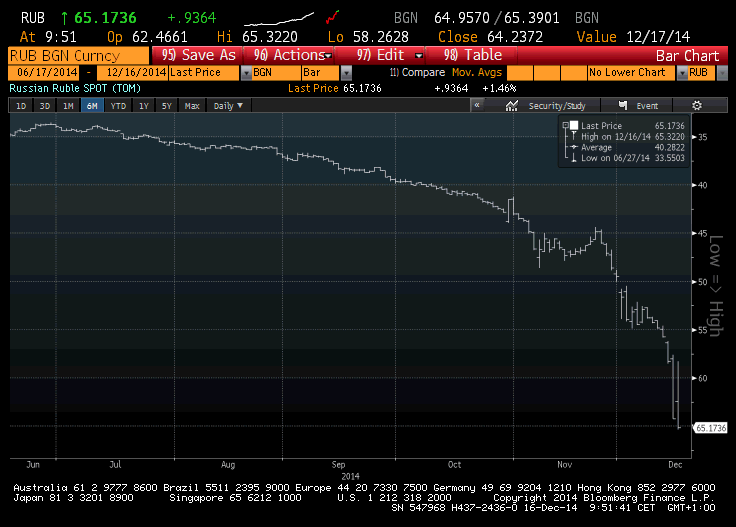
Big news today of the Russian Ruble's massive crash. Additional indicator for an article I plan on doing, comparing trends for metrics like oil imports, inflation, currency, and consumption for various countries in the last six months. A nice pet project for me to learn how to use Shiny.

Until then, this lazy correlation will have to suffice. It also serves as a reminder for me to actually finish this project.

Exhibit 1:
Russian Ruble over 6 months (Y = No. of Ruble I USD buys)

Exhibit 2: 
Price of Crude Oil over 6 months

Additional Reading and Sources:
- Source for Crude price chart: http://www.dailyfx.com/crude-oil
- Understanding the Ruble Collapse: http://www.nytimes.com/2014/12/16/upshot/vladimir-putin-vs-the-currency-markets-what-to-know-about-the-rubles-collapse.html


Sunday, 17 August 2014

Quora: On the rise of Kurdistan and regional impact

How will economic development from (oil) exploration and production in the Kurdish region effect Iraqi and Syrian politics? [http://qr.ae/u2Bp0]

The Kurdish Autonomous Region has enormous oil reserves,  a well-functioning democracy (compared to regional standards), and a thriving business environment. Free from the Sunni-Shia politicking in Baghdad, it has attracted significant investment and has the potential to grow into a significant economic presence in the region, which will alter its regional standing.

I'll divide my answer into two sections: The extent to which Kurdistan can grow, both economically and politically, and the possible impact of this growth on its neighbors.


Thursday, 17 July 2014

Quora: On Sabella and his choices as Argentina's coach

Question: Was it not an irony that Argentina produces four of the best coaches in the world but cannot employ a decent one for its own national team? [http://qr.ae/C8Oza]
You all know what Mauricio Pochettino and Diego Simeone did for their respective clubs (Southampton and Atletico Madrid) last season. You all saw to which heights Jorge Sampaoli and Jose Pekerman took Chile and Colombia in the just concluded World Cup. They all are of Argentine descent and nationality. If coaches of their quality can be produced by Argentina, why such an imbecile mediocre like Sabella should be bestowed on with the responsibility of coaching Argentina in the World Cup finals? He faltered in his team selection initially, in formulation of all his on field strategies, in choosing the best playing eleven and above all, in motivating his playing eleven, miserably. Why Augusto Fernandez or Maxi Rodriguez in the final 23 ahead of Javier Pastore? Why Federico Fernandez ahead of Martin Demichelis in the starting eleven? Why Aguero replacing Lavezzi when he was playing well and Aguero was not even able to run on the pitch properly? Why at all Rodrigo Palacio? It would be better if Diego Simeone takes over the reins of coaching La Albiceleste right after the imminent sacking/resignation of Alesandro Sabella, after the World Cup.

I'll try to answer this myopic question keeping in mind a rough timeline of events. Heads up, I might be a bit too close to this, so there might be the occasional nasty remark and incoherent rant.

The Disappointment of 2010-11

Argentina had just returned from a horrendous Copa America. And that had come on the back of an equally disastrous World Cup. The pool of players available for the 2010 WC was the best in quite some time for Argentina, IMO. It was the blend of the old guard that had established itself in Europe, and the fresh bunch from the batch that won the 2005 and 2007 U-20 World Cups. It was also the year that a Mourinho-led Inter Milan won the treble. Inter have always had a very strong Argentine presence, and it was their Argentine spine that won them the treble. The likes of Walter Samuel, Esteban Cambiasso, and the prolific Diego Milito led by the legendary Javier Zanetti turned in superb performances throughout the season to lead them to unprecedented glory. Messi was in great form, Higuain was thriving in Madrid, Aguero was making waves too. And Riquelme - my favorite player of all time - was having a stellar season too. This was a squad that was full of world-beaters and proven winners. But the only shortcoming - and the biggest one - was the coach: an inept, ineffectual, almost farcical Diego Maradona.


Sunday, 13 July 2014

WC2014 Finals Preview: Germany vs. Argentina

Let me first start off by saying how happy I am to see both my teams make it to the Finals! I was a delirious mess after the shoot-out that took Argentina to the finals. Italia 1990 was Argentina's last deep WC run, where they faced off West Germany in the finals and lost. It's strange to acknowledge that a footballing powerhouse has reached the semis for the first time in a generation or so. As Vijay pointed out to me, this is Argentina's golden generation at their peak, the class that won the U-20 WC both in 2005 and 2007. I'll argue that the Albiceleste had an excellent and a better pool of players to pick from in 2010, with the Argentine spine of Zanetti-Cambiasso-Milito leading Inter Milan to the treble, and Riquelme in fine form too. I'll hold Maradona eternally accountable for messing with that side. But that's been the story of Argentina ever since Italia '90. Losses in penalty shootouts, being drawn in the WC trope that is the 'Group of Death', and the curse of stubborn coaches.

Thursday, 10 July 2014

WC2014 Pre-Game Notes: Netherlands vs Argentina

Lineups

Netherlands (5-3-2): Cillessen; Kuyt, De Vrij, Vlaar, Martins Indi, Blind; De Jong, Sneijder, Wijnaldum; Robben, van Persie

Argentina (4-3-2-1): Romero; Zabaleta, Demichelis, Garay, Rojo; Enzo Pérez, Biglia, Mascherano; Lavezzi, Messi; Higuaín.

Notes: (I haven't followed Netherlands as much this WC, so forgive me if I make one too many mistakes on that front)

  • Good news for Netherlands as Van Persie fights off a rumored stomach bug to start alongside Robben. Van Gaal must be pleased to have his trusted captain for tonight's high-stakes game. But the big news today for Netherlands is the return of midfield destroyer De Jong, also known fondly as the Karate Kid. His intensity and ball-winning capabilities have been highly praised by his boss, and rightly so.
  • Enzo Perez comes in to replace the effervescent dynamo that is Di Maria, who'll be sorely missed today. Rojo comes back from suspension, and will be tasked with tracking Robben closely, which is an immensely important assignment. 
  • Sabella starts what looks like a very conservative lineup, with three robust midfielders. 
    • Gago, who has had a sub-par World Cup so far, has been benched. While his ball-playing abilities will be missed - especially with Di Maria's absence - his ponderous passing and lack of dynamism most likely contributed to his absence. This Netherlands squad have been noted for their intensity in midfield with smart pressing, recovering the ball in dangerous positions, finding Sneijder quickly, who looks for the quick outlet pass to the pacey Robben. Gago would've been a liability in these circumstances. 
    • Masch and Biglia did an excellent job curtailing the Belgian playmakers, even if they lacked a coherent plan. They should form a decent screen in front of the back four, and crowd out Sneijder and Wijnaldum. I personally liked Perez's energy in midfield, and hope he can link up play when necessary. This is critical, considering how much of the creative responsibility rests . on Messi today. Any unexpected player stepping up today should ease things for Messi, helping him do his job better.
    • Masch/Biglia on Sneijder: I personally found Sneijder's inclusion as a star in this Netherlands team at the start questionable, considering how much he'd tailed off since his glory days at Inter, considering it an indictment of the lack of quality in this squad. But he's slowly proven me wrong, carrying out his duties pretty well, improving his service to the front two in increments. Cutting off this supply line will be of the utmost importance to Argentina's fate today - alongside their ability to sustain pressure in midfield. This should cause Robben to drop deeper, taking him farther from his most potent areas. 
  • De Jong shackling Messi: 
    • Messi has been carrying this Argentina team throughout this tournament, with some truly sublime performances. In the Switzerland game, Behrami and Inler took turns to shut him down, and that plan almost worked. Belgium, in what turned out to be their undoing, left only Witsel to track Messi, leaving loads of space for the Barcelona man to thrive in. And he did just that. 
    • De Jong is a reputed holding midfielder, and he'd thrive in the dedicated job of disrupting Messi's play, tracking him closely. Netherlands will look to cut the supply lines to Messi - which is easier due to Di Maria's absence - forcing him deeper, and then proceeding to crowd him out. Martins Indi might push up into midfield too, to add an extra body.
  • Dutch width: Blind has been very good this tournament, with his intelligent crosses from deep dismantling Spain, and many other sides. He also contributes in the midfield scrap, adding vital numbers there, which is even more important in this game. Kuyt has grown into his Left Wingback position, marauding well and working hard, taking up an advanced position when Robben drifts infield. 
    • While the wingbacks have been the secondary attacking option for Netherlands - who've enjoyed playing on the break in the big games - it's a unique and important attacking option nonetheless. It also preys on the lack of width in this Argentine squad.
    • While Argentina revert to a flat 4-4-1-1 without the ball, that was with Lavezzi and Di Maria (natural widemen) in the side. And even they didn't track back diligently. With Perez (a Central Midfielder) coming into the side, the width without the ball is practically non-existent, giving enough room for Blind and Kuyt to use this option even more. It'll be a dangerous option, one that Argentina might not have an answer to. So please Argentina, don't replicate Spain's high defensive line. Robben and Van Persie would thrive with deep crosses into that space. 
  • Elaborating on the midfield battle: This game hinges on the midfield battle, more specifically on the outcomes of the Messi-vs-De Jong and Sneijder-vs-Masch battles. Argentina need to be able to withstand the Dutch pressing, be smart with their passes, and composed above all. Do not replicate Brazil's immaturity from last night. Expect a scrappy game, with De Jong disrupting play. Argentina need to be able to find the quick pass into space and run at the Dutch back-line, refuse to be pulled into the midfield scrap where Netherlands might edge out on athletic ability.
  • Unanswered - How to deal with Robben: While the obvious answer will be to expect Rojo to track Robben - who's had an excellent tournament so far - the problem arises when he drifts inside. Rojo can't abandon his position, because Lavezzi will not track back, leaving ample room for Kuyt to bomb into. Sure, Biglia can pick him up once he drifts inside sufficiently enough, but the few moments between the handoff from Rojo to Biglia, that's when Robben is most dangerous, cutting in on his left foot.
  • Expected pattern of the game: I expect Argentina to sit deep, and draw out the Dutch midfield, looking to find Messi whenever they can. Messi has played like a classic #10 this World Cup, and will also be tasked with running at the Dutch today, because of Di Maria's absence. Both these roles work best when Argentina are looking to break, and the Dutch will look to clamp down on any space whatsoever. Expect Higuain to struggle against the three-man defence, increasing the importance of Lavezzi in today's game. It'll be a scrappy, tactical affair, I'm predict.

Wednesday, 9 July 2014

WC2014 Pre-Game Notes: Brazil vs Germany

Lineups

BRAZIL (4-2-3-1): Julio Cesar; Maicon, David Luiz (c), Dante, Marcelo; Fernandinho, Luiz Gustavo; Hulk, Oscar, Bernard; Fred.

GERMANY (4-3-3): Neuer; Lahm, Boateng, Hummels, Howedes; Schweinsteiger, Khedira, Kroos; Muller, Klose, Ozil.

Notes:

  • Low sticks to the line-up he deployed against France. Klose and Ozil had relatively quiet games, to put it mildly, and it was a conservative set-up of sorts.
  • Bernard hogs the headlines, being Scolari's chosen replacement for Neymar. 
    • A like-for-like change, with the former Miniero winger who now plies his trade in Shakthar Donetsk is known for his speed and flair. 
    • His directness and pace will be of value if Germany use a high defensive line, but he goes up directly against Lahm. So unless he's horribly caught out very high up the pitch, Bernard should struggle tonight.
  • Dante's inclusion for the suspended captain Thiago Silva was predicted. Solid defender, I must say. It's good to see Luiz given the armband for tonight. Excellent chap who can be trusted to pull his team up when necessary. Also, the thunderbolt in the previous game should remind you why Chelsea fans lament his transfer to PSG.
    • EDIT: Kunal argues that Dante is suspect when defenders run at him, using Madrid's demolition of Bayern as a case in point. While that is true, I don't see Brazil play Guardiola's high-line and I don't think Brazil will look to boss the game in terms of possession. That was a case of Dante being run at after Madrid won the ball; Brazil will be looking to replicate Madrid today.
  • Maicon keeps his place over Dani Alves, with Scolari presumably being impressed with his performance against Colombia. He should bring in more discipline and experience to this Brazilian back-line who will be missing their most cool head in Thiago Silva, even if it can be argued that Silva's suspension was a result of a very stupid foul. He will look to bomb forward, as is his forte, but will stick to his positional duties better than Alves. Ozil must look to drift inside to trouble him.
  • Ozil finding space: Ozil keeps his place in spite of a lacklusture World Cup so far. So far, Brazil have left space between midfield and attack, the kind of situation Ozil should thrive in. The last classic #10 Brazil went up against, they hacked him to the ground repeatedly. He needs to have a good game today, with Kroos looking to influence play from a deeper position. 
  • Klose's off-the-ball movement: Klose doesn't have the pace to worry Dante and Luiz. What he does have is his experience and his intelligent movement. The reason why this is can become critical is because:
    • Dante-Luiz isn't the first-choice Center-back pairing, which means their communication is more suspect than the Silva-Luiz one. Also, in that pairing, Silva is the one tasked with keeping Luiz's concentration in check.
    • Klose is a classic poacher, ghosting in behind defences for his goals. This is set up for him very, very well.
  • Role of the Brazil's Full-backs: Marcelo and Maicon are pretty adept at bobing forward to get involved in the attack, and have shown their willingness to do so. The lack of pace that plagues the German back-line coupled with Ozil and Muller not tracking back provides the perfect opportunity for the two of them to selectively get forward, overlap with their wingers, and cause all kinds of problems for Germany. While this is a good idea on paper, the threat of being caught out of position without the ball must scare the living lights out of Scolari, which is why we may not see this happen too often. But when it does, watch out.
  • Neymar's absence, and Oscar's role: Neymar's injury has obviously dominated the headlines for Brazil; he's practically carried this Brazil side through in an attacking sense. The only game where he was relegated to a secondary role was the opening match where Oscar shone for Brazil. And Oscar needs to have that kind of game tonight again. 
    • If Low sticks to his high defensive line, that should reduce the kind of space between defence and midfield that Oscar loves, and he'll have to drop deeper into the midfield quagmire. With two direct wingers in Hulk and Bernard, I expect him to be looking for the quick outlet pass into the wings, release their speed-merchants and put the slow German back-line under pressure.
    • His defensive diligence will be important here, as he tracks Schweinsteiger who will taking on the deep-lying playmaker-cum-destroyer role. His pressure will be critical in determining the winner of the midfield battle, as Schweini can give up the ball early on before he's settled into the game, leading to quick breakaways against a slow back-line (I cannot stress that enough, can I?). Kroos-Khedira vs Gustavo-Fernandinho will be a stalemate, I think, with the balance tipping to Germany because Ozil will drift towards the middle.
  • Brazil's Opening Intensity: This is something that has been noted across the tournament. Brazil start off games with rabid intensity, pressing high up, trying to win the ball in dangerous positions, and looking to break away quickly. After 25 minutes or so, they wind down, allowing the opposition into the game. If Germany can survive this opening exchange, the game will come down to their strengths, as Kunal pointed out: Possession; Better passers; Intelligent runners.
I'd love to see Klose get his record-breaking 16th World Cup goal in this game. No better game to break the legendary Ronaldo's record than in his own backyard. 

Friday, 4 July 2014

WC2014 Knockouts Dossier: Germany

This is the first of the three dossiers I intend to do for the Knockout stages: One for Germany; one for Argentina; and the last one for Netherlands, following up on a request. 

Warning: Possible explicit language. All unedited.
-----------------------------------------------------------------------------------------------
Breakdown of Germany vs. Algeria

Lineups

 photo ger-alg_zps0c291c05.jpg
GERMANY (4-2-3-1): Neuer; Mustafi, Mertesacker, Boateng, Howedes; Schweinsteiger, Lahm; Ozil, Kroos, Gotze; Muller.

ALGERIA (4-5-1): Mbolhi; Ghoulam, Belkalem, Halliche, Mandi; Lacen, Soudani, Taider, Mostefa, Feghouli; Slimani.

Thursday, 19 June 2014

WC2014 Review: Argentina vs Bosnia & Herzegovina

Line-ups:


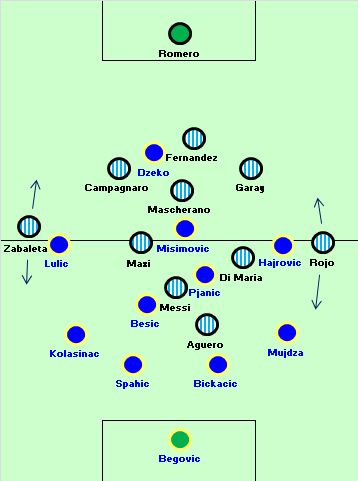
Argentina (5-3-2) - Romero; Zabaleta, Campagnaro, Fernandez, Garay, Marcos Rojo; Mascherano, Maxi Rodriguez, Di Maria; Aguero, Messi.
  • Sabella began with a 5-man back-line as Fernando Gago sustained a knock in training. 
  • Zabaleta and Rojo were expected to provide width to this side, but Rojo plays as a Centre-back for his club. 
  • Sabella moved away from the 4-3-3 he used in qualification, and chose to go with a particularly lightweight midfield - Di Maria is a winger who only played this season as a central midfielder, and Maxi Rodriguez isn't particularly kown for his ball-winning ability.
Bosnia (4-5-1) - Begovic; Mujdza, Spahic, Kolasinac, Bicakcic; Hajrovic, Pjanic, Misimovic; Besic, Lulic; Dzeko.
  • A fairly unfamiliar lineup, but one that got Bosnia to their first ever World Cup. The players to look out for would be Roma's Miralem Pjanic (who I've admired for quite a while), and Manchester City man Edin Dzeko. 
Courtesy: Zonal Marking

First Half: Score 1-0 to Argentina.


  • This was a pretty weak first half by Argentina. The lucky own goal aside, the 5-3-2 misfired horribly. Bosnia overran the Argentine midfield rather easily, pressing with rabid intensity and winning the ball in dangerous areas, swarming ahead with energy. With Mascherano being the only defensive name in midfield, the back-line inevitably became the first line of defense. 
  • The Argentine midfield saw very little of the ball in meaningful positions, which meant that Messi had to drop pretty deep to see the ball. He already had two men tracking him, and dropping into a crowded, energetic midfield only made it worse. He was practically anonymous in the first half, and couldn't link up with Di Maria or Aguero.
  • Aguero lacked sharpness and his contribution in the game, let alone this half, was very poor.
  • Zabaleta and Rojo were pinned back because of the midfield pressure. And this translated into very little width for the side, which made things worse.
Notes:
  • Argentina barely saw any shots on target. Messi saw very less of the ball and was surrounded and shut down quickly even when he did.
  • Bosnia were very dangerous on the break. Coupled with the static, outnumbered midfield and the rather slow back-line, this translated into increased pressure on the back 5.

Second Half: Ends 2-1 to Argentina.

  • Sabella realized his tactical mistake, and brought on Gago and Higuain, for Campagnaro and Maxi Rodriguez. 
    • A swtich to the reliable 4-3-3, with Masch acting as the defensive shield, Gago the ball recycler, and Di Maria the energetic midfielder linking defense and attack. 
    • Higuain and Aguero spear-headed the attack with Messi just behind them, forming a fluid 3-man strike force.
  • This tactical switch worked like a charm, as Gago's sensible work with the ball provided Di Maria and Messi with an outlet ball in the final third, the area where they're most potent. Also Gago's defensive work meant that Masch had a partner in closing down the Bosnian midfielders. Pjanic saw much less of the ball in the second half.
  • Higuain, although he was wasteful and couldn't link up with Messi or Aguero, did well in pushing back the Bosnian defenders. This opened up space for Messi, and that too in an area closer to the final third. Same goes for Aguero. But strikers of their calibre should be contributing much more.
  • Argentina began bossing the game in this half, but they couldn't translate that into meaningful shots or goals. Too often the pass was over-hit or the first touch was lacking. Even the usually buccaneering Di Maria ran into walls of defenders. Messi began influencing proceedings more, but even he couldn't get the final ball right. The fans began baying for the Barcelona Messi.
  • Messi's Goal:
    • It was thing of beauty. It was all Messi, dropping deep near the halfway line to receive the ball, then bursting ahead, exchanging a simple one-two with Higuain, running directly at the back-line, evading two tackles, and then arrowing the ball into the net off the post. Simply magnificent.
    • He utilized the space between attack and midfield created by Higuain's run, and burst in there to do what he does best. It was sumptuous stuff, and Messi in his element. 
    • With the stadium rocking now, every burst forward looked potent. This was the goal the side needed. 
  • Ibisevic's Goal: 
    • This was a clanger from Argentina's perspective. They slacked off towards the end. The back-line was disorganized and lazy, with the midfield not exerting even a token amount of pressure on the ball carrier. 
    • There was too much space between the two centre-backs which Ibisevic used to run past his marker and lose him. This highlighted our inability to deal with a traditional two-striker system.
    • Romero's fumble as a goalie was just unforgivable, especially if we have title aspirations.

Remarks:

  • It's a very shaky back-line that need to work a lot on the training ground. We will struggle a lot against a fluid, interchanging strike-force. Or even a direct, physical striker. And Romero's slip does not inspire any confidence. 
  • While Gago will defintely start the next game, the lack of depth in this Argentina squad is scary.
  • Aguero and Higuain need to turn up, and start influencing proceedings more if this side are to have any chance at the World Cup. Over-reliance on Messi is not a good thing, as Barcelona can attest to. Movement will be the key to unlocking a well-drilled, ultra-defensive Iran side.
  • Even in a 4-3-3, this side lacks natural width. Rojo can't bomb forward effectively, while Higuain and Aguero are more central strikers. The lack of options can come really restrict us.
  • Sabella's organization of the team when they are chasing the ball needs to improve a lot, because we just look disorganized and out of sync, waiting to be carved apart by two incisive passes. Also, the lack of pace while tracking back is a glaring weakness.

Friday, 13 June 2014

WC2014 Notes: It's Time!

It's World Cup season!

It's that time again, when in spite of knowing the specific shortcomings of a lopsided Argentine squad, I'll root for them with all my heart. When in spite of mathematical odds and detailed tactical sheets, I hope to see the Albiceleste triumph.

For this edition, I thought I'd chronicle the World Cup through my blog. I've supported Argentina ever since I was a kid. They were my introduction to the sport - courtesy my fanatical cousins - and have always remained my benchmark for the way the game should be played. I remember the days of the maestro Riquelme, the beauty of one-touch football. Not the slow, sterile tiki-taka stuff that Spain parades, but a vibrant, effervescent style, full of energy and verve. The original way. The Argentine way.

And then there's Germany. I don't remember the precise moment I began supporting them, but I remember being in awe of Oliver Kahn in 2002, and cheering them on vociferously in 2006. They captured everyone's imagination with that breathtaking run in 2010 with a young squad, playing swift, incisive football. But the way they imploded in Euro 2012, that was a dagger through my heart. And that sowed the seeds of doubt in my mind against Joachim Low and his tactical flexibility.

Anyway, rhapsodizing aside, I'll be chronicling this World Cup from the vantage point of both these teams. They're close to my heart, and I love watching them play. I spend a considerable chunk of my day devouring football news, so hey, that habit may finally prove handy! There will be a lot of amateur analysis, a fair collection of expletives and reactions, and I'll try to incorporate stats from Opta. And most of it will be unedited and fairly disparate, maybe even random. Just like my live-tweets over @adarshmathew92.

Honestly, I'll be making this stuff up as I go along.

I'd originally envisaged this project as a fun, private one, to keep myself entertained. But Sony's coverage of the event has disappointed me massively. I understand that you need star power in coverage, especially in India. But the case here isn't one of introducing a sport to a completely new market. We have a fairly intelligent and a very passionate footballing community; I've seen fistfights break out over football games. Sony could at least treat us with a modicum of respect, like intelligent viewers who know the game. Peter Crouch and Mikael Silvestre as pundits is just laughable. John Abraham and the-guy-who-does-IPL are just incompetent nincompoops. Every person in the country who's even half-interested in the game is tuning into Sony LIV right now. This would've been the best chance to introduce this audience to local pundits who cover Indian Football, promote the local game. They would definitely bring in a greater degree of enthusiasm and understanding to the coverage, and would also get a chance to familiarize themselves with the audience. Even more, Sony could've set themselves apart by being promoters of local talent, unlike STAR Sports and TEN Sports who just regurgitate England's telecast. Such a wonderful chance, blown to dust.

So, a part of me is doing this just to show that sensible, intelligent coverage of an international footballing event by local entities is possible and feasible. I'm not a sports journo, or qualified in any sense of the word. I'm just your regular footballing nutjob who loves his Manchester United crest a little too much.

So here's to an excellent World Cup. May you be thrilled and entertained, as football always aims to do.

Next in the series: Detailed previews for Argentina and Germany!

Thursday, 19 December 2013

Non-Conventional Oil and OPEC's Drawdown

The OPEC’s traditional stranglehold over the world’s oil resources has eroded over the past few years. Part of it can be attributed to improved technology resulting in engines that are more efficient, along with the community’s desire to wean itself off oil. But a large chunk of this must be attributed to the discovery of other avenues of oil and energy. For instance, Brazil’s advanced deep-water drilling activities have provided the market with an alternate option to the parsimonious OPEC. Advancements in off-shore drilling and improvements in shale rock hydraulic fracturing – or fracking – have altered the erstwhile inelastic energy market.

Wednesday, 11 December 2013

[Draft] When Municipal Law and International Agreements Intersect.

In 2007, before the US-India Civil Nuclear Deal could be fully ratified, the Bush administration had to address a small wrinkle. The US couldn’t get into any nuclear deal or agreement with India according to its laws, as India wasn’t a signatory to the Nuclear Non-Proliferation Treaty and outside the IAEA’s jurisdiction. Before the deal could be ratified by Congress, US law had to be amended to accommodate India. Subsequently, the US got us an exemption from the Nuclear Suppliers’ Group, and we stopped being a nuclear pariah. 

Tuesday, 26 November 2013

How to Undo the Results of a Year-long Negotiation

Brought to you by the US Congress and their friends in Israel 


President Hassan Rouhani of Iran has had a tumultuous three months in office. After campaigning on a moderate plank and eking out a shock victory, he garnered enough support within the country for negotiations with the P5+1, and even the grudging support of the Supreme Leader Ayatollah Khomeini. He and his team of negotiators have hammered out a historic deal where Iran would cap its uranium enrichment at 3.5 percent, and in return the US would relax sanctions worth USD 7 billion against the economically-stricken country. To emphasize the magnitude of this deal, every US president since Carter has been trying to hammer out a deal with the Iranians; President Obama is the only one who has got a deal.

Wednesday, 12 June 2013

The Writer's Monkey

Fade In.
I see myself standing alone, in a room without walls. It’s seamless, without boundaries, and I can see the place go on for miles, under bright sharp lights. I see clumps of words drifting alongside me, like a murky river. I recognize words and phrases; I chuckle as I see some of my preferred colloquialisms. I lean over to the right, and gaze into the stream, trying to make sense of what’s in there. I stare long and hard. And I realize that it’s slipping away. The harder I try to make sense of what’s in there, the longer I gaze, the less I can make sense of it all. I stand up and look around, and feel the tumble of words all round me. It’s overwhelming. I let go. I give up.

Saturday, 1 December 2012

First Quora Answer! :-D

Question: Presidential System vs English Westminster model - Should India adopt the Presidential system over the Westminster model?

The recent furore over 'Policy Paralysis' in India has been put down to the inefficiencies of the Westminster model. This, juxtaposed with the US Elections of 2012, has got a lot of people talking about the viability of a Presidential System in India.What exactly are the shortcomings of the present system? What are the factors at play? The success of the Presidential System in the US should be attributed to what? Is there a major difference in Governance?

I'll try to answer the 'Policy Paralysis' bit keeping India as the context, as I feel Balaji Viswanathan's answer has covered the straightforward comparison of both models.

Friday, 16 November 2012

The Spartan Life - An Experiment

It was 2:30 am. I was unable to get myself to focus on Forward Rate Agreements - Financial Engineering was proving to be an incredibly difficult subject. I got a call from Vikrant, asking if I wanted to grab some food. I wasn't particularly hungry, but my brain went: What the heck, you might as well go for it.

Lallu was closing down, but luckily, Eggies was open.

We started an interesting discussion about the meaning of a spartan life. What exactly do you need for survival? For subsistence? What forms the core of your existence? What precisely do I need to live life?
Or, in this age of excesses, what can I do without?

Tuesday, 7 August 2012

Satyameva Jayate – Precursor to Social Reform or Just a TRP Gimmick?

Aamir Khan isn’t a name like any other in Bollywood. He refuses to attend the glitzy award shows; he has carefully cultivated the image of being a perfectionist and the pioneer of intelligent cinema; he has lent his name to quite a few social causes, even controversial ones. So when the STAR network announced a TV show featuring Aamir Khan which would, in its own words, ‘bring out social issues in front of the public’, everybody sat up and took notice.  On its national premiere, the show was hailed as one of the best shows on Indian television ever. Aired on the 11am slot once held by the epic Ramayana, Satyameva Jayate brought India together in front of its television sets, cutting across lines of religion, language, and taste, like its predecessor. Sunday updates on social media are dedicated to the ‘sheer brilliance’ of the show. Some have even gone as far as to say that the show is the beginning of India’s social revolution. But for a country that is fractured on several fronts, can a television show actually bring about such change?

Media Ethics – The Balance between Right and Wrong

The Big Question: To inform or to foment opinion. Building on that, what to inform and what opinion to foment?

Last year, News of the World shut shop. Amidst allegations of phone hacking, and severe public backlash, several high-profile advertisers pulled out, forcing Rupert Murdoch; head of the parent conglomerate News Corporation; to close down the newspaper. That a successful and powerful organization was brought to its knees because of repeated violations of the most basic of journalistic ethics makes one thing clear –the justification for the investigative practices of media bodies are highly subjective and often sketchy. And this brings us to a larger question – what exactly drives newsgroups to do what they do? Why are some stories pursued relentlessly, while some are left to languish?